Blog

  • TOP 5 EUROVISION ROCK/METAL SONGS Part 3 #eurovision #eurovisionsongcontest #wigwam

    TOP 5 EUROVISION ROCK/METAL SONGS Part 3 #eurovision #eurovisionsongcontest #wigwam – Mixed Signals

    Video

    https://www.youtube.com/watch?v=b5Pq-AMN7xA

    Summary

    Summary:
    We watched 20 years of Eurovision and found the top 5 Rock and Metal songs of the last 20 years. Some may be surprised there’s no hard rock, but one year earlier, an act paid tribute to Glam Rock with badass riffs and a catchy chorus. The guaranteed earworm is Norway’s 2005 entry, Wigwam, with „In My Dreams“. 🎵🤘

    Highlights:
    – Top 5 Rock and Metal songs of the last 20 years at Eurovision
    – No hard rock in the list
    – Glam Rock tribute with badass riffs and catchy chorus
    – Norway’s 2005 entry „In My Dreams“ by Wigwam 🎵🤘

    Key Takeaways:
    – Eurovision has a variety of rock genres represented
    – Glam Rock is not commonly associated with Eurovision, but can still make an impact
    – „In My Dreams“ by Wigwam showcases the power of catchy choruses and strong riffs in making a memorable song 🎵🤘


  • Google MusicLM is about to change music forever

    Google MusicLM is about to change music forever – Mixed Signals

    Video

    https://www.youtube.com/watch?v=p56949cL9_s

    Summary

    ### Summary

    Google has released a new music generation model called MusicLM, which allows users to generate music from text-based prompts and produce long sequences of audio while maintaining coherence. The tool can create music based on simple prompts, take multiple prompts with timestamps, seed music generation with a given melody and transform it into a full arrangement, and more. Subscribe to the channel to stay updated on this technology’s potential impact on the future of music making.

    Highlights

    • MusicLM generates music from text-based prompts
    • Can produce long sequences of audio while maintaining coherence
    • Tool creates music based on simple prompts, takes multiple prompts with timestamps, seeds music generation with a given melody and transforms it into a full arrangement in the specified style

    Key Takeaways

    • Google’s MusicLM is an innovative tool that allows users to generate music from text-based prompts and create long sequences of audio while maintaining coherence.
    • The possibilities for music creation are endless, and we’ll be discussing more of these in an upcoming video!
  • Make your own radio show with Spotify’s Music + Talk feature!

    Make your own radio show with Spotify’s Music + Talk feature! – Mixed Signals

    Video

    https://www.youtube.com/watch?v=1DuepbNFAEA

    Summary

    ### Summary

    Berk has a Music and Talk show on Spotify called Taste Cauldron. The show is a personalized radio show that combines music and spoken word to create unique playlists. Berk sends these every couple of weeks, providing context and discussing the songs and artists, which inspires listeners to discover more music.

    Highlights

    • Music and Talk feature on Spotify
    • Personalized radio show format with music and spoken word
    • Inspires discovery of new music

    Key Takeaways

    • Taste Cauldron is a Music and Talk show by Berk on Spotify
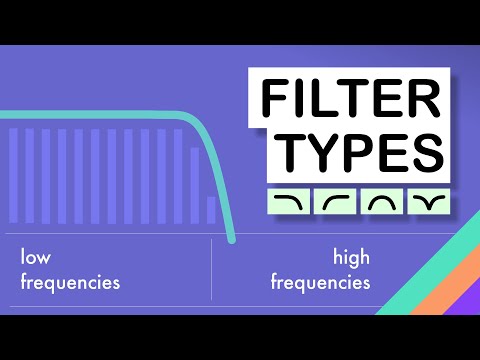
  • Low pass, High pass, Band pass and Band stop filters explained

    Low pass, High pass, Band pass and Band stop filters explained – Mixed Signals

    Video

    https://www.youtube.com/watch?v=RAhcsDwp7iA

    Summary

    ### Summary
    A low-pass filter passes frequencies below the cutoff frequency, attenuating those above it. High-pass filters do the opposite, passing frequencies above their cutoff frequency and attenuating those below. Band-pass filters allow frequencies around their cutoff frequency to pass through while blocking higher and lower ones. Band-stop or rejection filters block frequencies around their cutoff frequency and pass all others. Notch filters are a very aggressive form of band-stop filters.

    Highlights

    • Low-pass filters: pass frequencies below the cutoff, attenuate above. :filter::tophat:
    • High-pass filters: pass frequencies above the cutoff, attenuate below. :filter::tophat:
    • Band-pass filters: pass frequencies around the cutoff frequency. :filter::tophat:
    • Band-stop or rejection filters: block frequencies around the cutoff frequency. :filter::tophat:
    • Notch filters: very aggressive band-stop filters. :filter::tophat:

    Key Takeaways

    • Knowing the types of filters helps in controlling and manipulating sound frequencies.
    • Filters are used in various applications like audio processing, signal processing, etc.
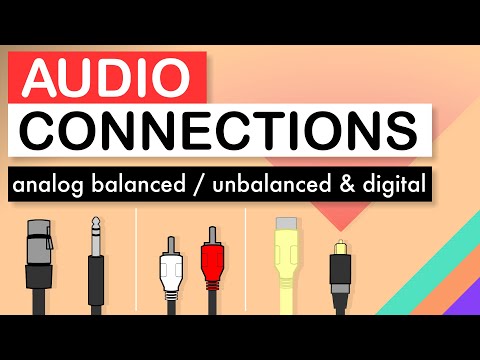
  • Common types of audio cables and their uses. Analog Balanced / Unbalanced & Digital

    Common types of audio cables and their uses. Analog Balanced / Unbalanced & Digital – Mixed Signals

    Video

    https://www.youtube.com/watch?v=617z88J8060

    Summary

    ### Summary

    This text focuses on the different analog and digital connections commonly found in music production and playback gear. It emphasizes unbalanced connections like mono and stereo 1/4 inch TS and TRS jacks, 1/8 inch or 3.5mm TS and TRS mini jacks, and RCA connectors. Balanced connections include the XLR connector, TRS jack, XLR TRS combo jack, and DB25. Digital connections discussed are SPDIF, ADAT, and MIDI, which use various types of cables and connectors to transmit audio or control signals.

    Highlights

    • 📼 Discusses analog and digital connections in music gear
    • 🔌 Unbalanced connections: TS & TRS jacks, mini jacks, RCA connectors
    • 🎛️ Balanced connections: XLR connector, TRS jack, XLR TRS combo jack, DB25
    • 🖥️ Digital connections: SPDIF, ADAT, MIDI (use various cables/connectors)

    Key Takeaways

    • 🎛️ Understand the difference between unbalanced and balanced connections
    • 📡 Learn about various connectors used in analog and digital music gear
    • 🖇️ Know what types of cables and connectors are used for transmitting audio or control signals
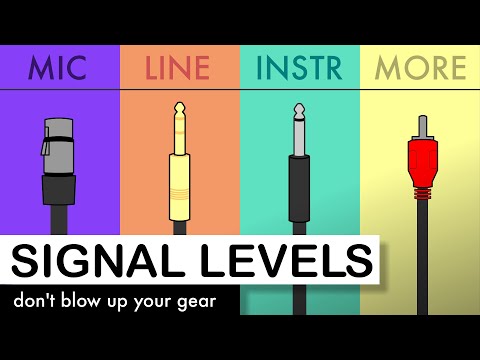
  • Audio signal levels explained: Mic level vs line level vs instrument level

    Audio signal levels explained: Mic level vs line level vs instrument level – Mixed Signals

    Video

    https://www.youtube.com/watch?v=Lxq2T0r3Jy4

    Summary

    ### Summary: Understanding Audio Signal Levels 🎤, 🎧, 📺, 🎬, 🎹

    This text covers various types of audio signal levels, such as line level, mic level, and instrument level. Line level is the standard signal used in audio systems and is a voltage level transmitted between devices. Mic level signals are weaker and require amplification to reach line level using a mic preamp. Instrument level signals come from electric guitars, basses, and some keyboards or synths; they can be high impedance and should not be connected directly to line level equipment. There are methods for connecting instrument level signals to line level, including dedicated instrument preamps, Hi-Z inputs on a mic preamp, or a DI box. Other signal levels mentioned include phono signals from turntables, which require special phono preamps for amplification and equalization.

  • How dynamic and condenser microphones work

    How dynamic and condenser microphones work – Mixed Signals

    Video

    https://www.youtube.com/watch?v=Bt7vXL1_Y1Y

    Summary

    ### Summary

    The text explains how dynamic and condenser microphones work, highlighting their key differences. Dynamic mics use electromagnetic induction, while condenser mics function as capacitors with a metal diaphragm and back plate. Condenser mics require external power, which can be provided by batteries or an XLR cable.

    Highlights

    • 🎤 Dynamic mics use electromagnetic induction for sound conversion
    • 🎤 Condenser mics function as capacitors with metal diaphragm and back plate
    • 🎤 Condenser mics require external power (batteries, XLR cable, or USB)

    Key Takeaways

    • 🎹 Dynamic microphones are passive and do not need external power
    • 🎹 Condenser microphones are active and require power sources
  • Radiohead guess the song challenge Part 3

    Radiohead guess the song challenge Part 3 – Mixed Signals

    Video

    https://www.youtube.com/watch?v=h1omUaihg5g

    Summary

    ### Summary
    The text is a transcript of a conversation where participants are trying to identify a particular Radiohead song. They discuss the possibility of it being Daydreaming, True Love Waits, or Desert Island Disk. The conversation is filled with humor, guesses, and a playful meta-level discussion about identifying the right sample.

    Highlights

    • Conversation about identifying a Radiohead song
    • Possible songs: Daydreaming, True Love Waits, or Desert Island Disk
    • Playful and humorous dialogue
    • Discussion of samples and their reappearances in different tracks Pyramid Song or Pulk/Pull?

    Key Takeaways

    • The speaker is unsure but thinks the sample might be in both Pyramid Song and Pulk/Pull
    • They mention other Radiohead songs and even guess that it could be in „Codex“ or „Giving Up the Ghost“
    • They ultimately choose „Giving Up the Ghost“ as their final answer, much to their own surprise
    • The speaker says it’s difficult to determine whether a particular song belongs to „The Bends“ album or „A Moon Shaped Pool“
  • Where I End and You Begin (Radiohead Touche Cover)

    Where I End and You Begin (Radiohead Touche Cover) – Mixed Signals

    Video

    https://www.youtube.com/watch?v=obbSejMTSmU

    Summary

    ### Summary
    The transcript discusses various topics, including AI’s impact on the art industry, Olivia Rodrigo’s singing talent, and Elton John’s skills as a pianist. It also touches on the collaboration between artists and technology.

    Highlights

    • 🤖 Artists are afraid of AI and its potential to replace their jobs
    • 🎤 Olivia Rodrigo is an emerging singer with a bright future
    • 🎹 Elton John is not just a singer but also a talented pianist

    Key Takeaways

    • 📚 The art industry needs to adapt to the changes brought by AI and technology
    • 🌟 Olivia Rodrigo’s success serves as an inspiration for young artists
    • 🎵 Elton John’s versatility demonstrates the importance of mastering multiple skills
  • Improve the Touché SE / Control Ableton & Hardware / No More Lié

    Improve the Touché SE / Control Ableton & Hardware / No More Lié – Mixed Signals

    Video

    https://www.youtube.com/watch?v=YDLLS8QdrXk

    Summary

    ### Summary
    This transcript is about using a MIDI controller for sound design and demonstrates various examples with a Max for Live patch. The speaker shows how to assign parameters like filter resonance, pitch, and send levels to the controller for different effects and styles. They also discuss using Ableton’s Wavetable synthesis and FM examples with Operator. Finally, they mention Lia, a plugin that hosts VST instruments within a DAW, but express concerns about workflow and having VSTs inside other VSTs.

    Highlights

    • Touchette SC is an expressive MIDI controller
    • Two versions: Original Big Boy Touchette and Special Little Brother Touchette SC
    • Touchette is a chunky plastic controller that detects pressure towards the bottom, top, left, and right
    • Ableton’s Wavetable synthesis and FM examples with Operator are discussed
    • Lia is a plugin that hosts VST instruments within a DAW

    Key Takeaways

    • Touchette SC allows control of VST Instruments, Ableton’s own synthesizers, Ableton itself, and Hardware
    • Max for Live offers mappable control
    • Inspired by Ableton’s expression control
    • Three fundamental changes to the original Share patch: assign buttons to any function, blocked original CCs in new assignments, adjust time response of Touché