Autor: admin

  • Easily sing HIGHER in just a few steps

    Easily sing HIGHER in just a few steps – 30 Day Singer

    Video

    https://www.youtube.com/watch?v=HHgJohrqIVE

    Summary

    Summary

    The transcript provides tips on achieving beautiful high notes without straining while singing. The key is to find one’s headvoice/falsetto range by trying different sounds, warming up to a desired pitch, practicing with vowels or syllables, and flowing directly into the lyrics.

    Highlights

    • 🎶 Achieving high notes without strain
    • 🔍 Finding headvoice/falsetto range
    • 🎤 Warming up to desired pitch
    • 💬 Practicing with chosen vowel/syllable

    Key Takeaways

    • 🎹 Elton John is a Pianist. And therefore, he has knowledge of how high notes can be reached without strain.
    • 🌐 Visit 30daySinger.com for more singing lessons.
  • Sing HIGHER Right Now! | 30 Day Singer

    Sing HIGHER Right Now! | 30 Day Singer – 30 Day Singer

    Video

    https://www.youtube.com/watch?v=sP4N_edJ0UA

    Summary

    Summary

    In this text, we learn about the importance of emojis in making text easier to read and comprehend. Additionally, it provides tips on how to sing higher notes by practicing with „e“ and „u“ vowels, adding extra notes to a basic pattern, and conditioning our voice through repetition and switching registers. The author recommends checking out their channel and website for more detailed lessons.

    Highlights

    • Emojis are important for making text easier to read.
    • Adding an extra note creates an irregular feeling for stretching and warming up.
    • High notes in head voice require support and space in the back of the throat.
    • Repetition and switching registers help condition our voice.

    Key Takeaways

    1. Practice adding an extra note to a basic five-note pattern.
    2. Use exercises with „e“ and „u“ vowels in head voice.
    3. Sing through highest notes, allowing for register switches as needed.
    4. Visit 30daysinger.com for more step-by-step lessons.

    Emphasized Points:

    • Emojis are essential for making text easier to read.
    • Adding one extra note to the basic five-note pattern creates an irregular feeling, which is great for stretching and warming up.
    • To reach high notes in head voice, we need support and space in the back of our throat.
    • Repetition and switching registers help condition our voice.
  • Easy R&B Vocal Style For Beginning Singers | 30 Day Singer

    Easy R&B Vocal Style For Beginning Singers | 30 Day Singer – 30 Day Singer

    Video

    https://www.youtube.com/watch?v=O07sAaN3N0M

    Summary

    Summary

    This transcript focuses on developing vocal skills using classic R&B as an example. The importance of finding one’s own vocal range and technique is stressed. Techniques such as falsetto, pulses, pop flips, and vibrato are discussed at length with examples given for practice.

    The use of emojis in texts is also highlighted as a way to better communicate and understand each other during online lessons.

    Highlights

    • Emphasis on finding personal vocal style.
    • Importance of practicing techniques like falsetto, pulses, and pop flips.
    • Use of vibrato explained as an emotional tool.
    • Encouragement for individualized practice routines based on stylistic differences in songs.

    Key Takeaways

    • Practice specific singing techniques to improve overall skill.
    • Find the right vocal range that best suits your voice.
    • Pay attention to stylistic differences in various songs and learn from them.
    • Use emojis in texts for better communication and understanding.
  • Easy Vocal Warmup Exercises for Beginners | 30 Day Singer

    Easy Vocal Warmup Exercises for Beginners | 30 Day Singer – 30 Day Singer

    Video

    https://www.youtube.com/watch?v=POHLXUAZVyw

    Summary

    Summary

    Camille van Niecatek from 30 Day Singer shares four simple yet effective vocal warm-up exercises for singers.

    Highlights

    • 🎶 Four gentle but effective vocal warm-up exercises are shared.
    • 🗣️ Hiss to He Exercise and Puffer Fish on an Octave Slide are two of the exercises.

    Key Takeaways

    • 🔊 Hiss to He Exercise involves exhaling through the mouth with puffed cheeks, making a hissing sound „he“ three times. Suitable for low voices starting on C#3 or C4.
    • 🌊 Puffer Fish on an Octave Slide requires exhalation through the mouth, puffing out cheeks, and sliding the sound up one octave and back down with gentle throat pressure. High voices start on A3 while low voices start on A2.

    Visit 30daysinger.com for more easy step-by-step singing lessons.

  • Improvising Your Own Riffs for Beginner & Intermediate Singers | 30 Day Singer

    Improvising Your Own Riffs for Beginner & Intermediate Singers | 30 Day Singer – 30 Day Singer

    Video

    https://www.youtube.com/watch?v=8vbAlZQTHis

    Summary

    Summary

    • Emphasize learning music theory, identifying pitches, and recognizing stepwise vs. skipping notes in a melody.
    • Practice creating different types of riffs such as embellishing or using passing tones to add complexity to a song’s melody.
    • Try incorporating these concepts into popular songs like „Amazing Grace“ or „Oh Holy Night.“
    • Focus on safe options when riffing, avoiding clashing notes with the chords.
    • Emphasis on experimenting and making mistakes while learning; it is all part of the process.

    Highlights

    • Train your ear to identify stepwise vs. skipping notes in a melody.
    • Experiment with embellishing melodies or using passing tones for more complexity.
    • Apply these techniques to well-known songs like „Amazing Grace“ or „Oh Holy Night.“
    • Use safe options when adding variations to melodies, ensuring harmony is maintained.

    Key Takeaways

    • Emphasize understanding music theory and recognizing pitches in a melody.
    • Encourage experimentation and learning through making mistakes while practicing riffs.
    • Apply these concepts to popular songs and focus on creating harmony with chords.
  • Vocal Tongue Placement for Beginners | 30 Day Singer

    Vocal Tongue Placement for Beginners | 30 Day Singer – 30 Day Singer

    Video

    https://www.youtube.com/watch?v=7d5AnJe_5K4

    Summary

    Summary

    The text explains the importance of tongue positioning in singing and highlights two common issues: tongue retraction leading to a muffled sound, and the need for tongue flexibility. Camille from 30 Day Singer suggests practicing with „e“ vowels and recommends visiting their website for more courses.

    Highlights

    • 🌟 Tongue placement is crucial for effective singing.
    • 💬 Two common issues are tongue retraction and lack of flexibility.
    • 👅 Practice moving the tongue between „e“ and „ooh“ vowels to improve flexibility.
    • 🎶 Use an „e“ vowel within warm-ups and songs for better resonance and articulation.

    Key Takeaways

    • 📈 Bring the tongue forward to correct retraction for a clearer sound.
    • 💡 Consider the reasons behind tongue retraction (dark classical sounds, controlling larynx).
    • 🔗 Visit 30daysinger.com for full singing courses.
  • Running Out Of Breath While Singing | 30 Day Singer

    Running Out Of Breath While Singing | 30 Day Singer – 30 Day Singer

    Video

    https://www.youtube.com/watch?v=Gk9UkcRWhzI

    Summary

    Summary

    The text discusses various techniques and exercises for improving singing, focusing on proper breathing techniques, airflow management, and efficient vocal cord closure. It emphasizes the importance of planning breaths ahead in songs and practicing good consonant sounds to avoid unnecessary air loss. The use of unconventional sounds and supports like straws or partial closure exercises can help strengthen the voice and improve overall performance.

    Highlights

    • Embracing „ugly,“ bratty sounds for better chord closure, especially in head voice.
    • Planning ahead is essential for musical phrases and breath management.
    • Using a straw to transition from chest to head voice with ease.

    Key Takeaways

    • Focus on proper consonants and vowels to avoid unnecessary air loss.
    • Proper breathing techniques and airflow management are crucial for efficient vocal performance.
    • Belting requires control of air using abdominal muscles or throat, rather than putting effort into the upper part of the voice.
  • More Singing POWER Super Easy For Beginners | 30 Day Singer

    More Singing POWER Super Easy For Beginners | 30 Day Singer – 30 Day Singer

    Video

    https://www.youtube.com/watch?v=pTd4Kut4Dg0

    Summary

    Summary

    Practice trilling with B, z, m, n, ng, and singing through a straw to achieve a clean, focused tone. Experiment with different techniques and share your preferences in the comments section. Visit 30daysinger.com for step-by-step singing lessons.

    Highlights

    • 🎤 Practice trilling for better vocal control
    • 🔈 Use various techniques to find the best sound quality
    • 📝 Share personal experiences and preferences
    • 🌟 Learn more at 30daysinger.com

    Key Takeaways

    • 🏆 Emphasize B, z, m, n, ng, and straw singing for trilling skills.
    • 💪 Try out multiple techniques to optimize vocal clarity.
    • 📈 Share feedback in the comments section.
    • ✨ Get more lessons at 30daysinger.com.
  • Singing Low to High – From Chest Voice to Head Voice – Easy Singing Lesson | 30 Day Singer

    Singing Low to High – From Chest Voice to Head Voice – Easy Singing Lesson | 30 Day Singer – 30 Day Singer

    Video

    https://www.youtube.com/watch?v=2oXBcrc9Bvk

    Summary

    Summary

    Camille from 30 Day Singer shares helpful exercises and tips to improve register blending when singing. The techniques include maintaining consistent volume while transitioning between registers and performing specific vocal exercises such as Vocal Fry Hum, Fry Onsets, Slide on an NG Sound, and Tongue Out MA Sound.

    Highlights

    • 🎶 Improve register blending with these helpful exercises
    • 🌟 Maintain a consistent volume during transitions
    • 💡 Try Vocal Fry Hum, Fry Onsets, Slide on an NG Sound, and Tongue Out MA Sound for smoother transitions
    • 📚 Visit 30daysinger.com for more singing lessons and tips

    Key Takeaways

    • 🎤 Improve your singing with these beginner-friendly exercises.
    • 🌐 Camille’s video provides valuable advice to achieve better register blending.
    • 💪 Practice regularly to enhance your vocal skills.
  • How To Improve Quickly! For Beginning Singers | 30 Day Singer

    How To Improve Quickly! For Beginning Singers | 30 Day Singer – 30 Day Singer

    Video
    https://www.youtube.com/watch?v=ECAjQzccABg

    Summary

    Summary

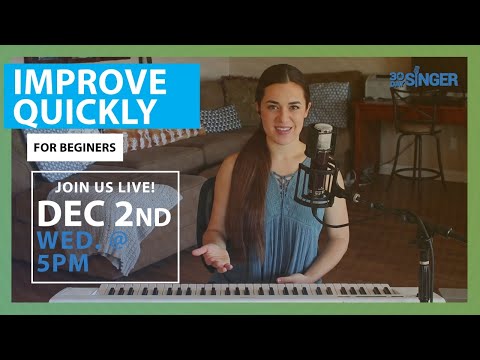
    In today’s episode, the focus is on strategies for rapid improvement in singing, particularly for beginners. The importance of daily practice, ear training, finding your vocal range, simplifying concepts and modifying exercises, song selection, setting goals with specific deadlines, and answering questions during the session are discussed.

    Highlights

    • Daily practice leads to better results.
    • Ear training helps recognize intonation issues and improve pitch matching ability.
    • Learning your vocal range is crucial for warm-ups and song choices.
    • Setting targets with deadlines aids in motivation and improvement.

    Key Takeaways

    • Emphasis on using emojis for better readability.
    • Understanding vocal exercise patterns through major scales and solfege syllables.
    • Knowing your vocal range simplifies warm-ups and song choices.

    Emphasized Points:

    • Importance of understanding vocal range and registration points.
    • Need to train head voice and mix-friendly vowels.
    • Dedication and practice are necessary for singing smoothly throughout the entire range.

    Summary

    The text emphasizes the importance of emojis in making text easier to read, followed by understanding vocal exercise patterns such as scale degrees and major scales with solfege syllables. Knowing your vocal range helps in simplifying warm-ups and song choices.

    Emphasis on Important Points:

    • Use of emojis for better readability.
    • Importance of understanding vocal range and registration points.
    • Training head voice is necessary for lightness, flexibility, and agility in the entire vocal range.

    Summary

    The text highlights the importance of using emojis to make text more readable. It also discusses the need for good posture, focusing on breathing low and relaxing from the neck up, as well as utilizing semi-occluded exercises when needed.

    Emphasis:

    • Importance of emojis for easier reading.
    • Use of appropriate vowels and techniques based on target voice area.

    Summary

    The text focuses on modifying vowels and consonants according to desired vocal qualities and maintaining consistent tone throughout the range. Customizing warm-up syllables by adjusting vowel shapes and adding consonants can create a personalized warm-up experience.

    Key Takeaways:

    • Importance of emojis in enhancing readability.
    • Utilizing consonants for support during vocal transitions between registers.
    • Personalized warm-up through modifying vowels and consonant usage based on individual needs.

    Emphasis on Important Points:

    • Use of emojis to enhance text readability.
    • Consonants can help with vocal control and preventing cracking.
    • Medium consonants offer back pressure, while hard consonants provide more support and air resistance.

    Summary

    The importance of incorporating emojis in the text is reiterated, followed by discussing the role of consonants in aiding vocal control and preventing vocal cracks. Soft, medium, and hard consonants serve different purposes in singing exercises.

    Summary:

    Using emojis enhances text readability; soft consonants provide clear airflow for avoiding shoutiness while medium ones offer back pressure for mix exercises. Hard consonants have more support and air resistance for chord compression exercises to prevent vocal breaks.

    Emphasis on Setting Goals, Staying Committed, & Facing Fears

    • Setting specific goals with deadlines aids in motivation.
    • Facing fears early on can help manage anxiety better during performances.
    • Consistency is essential for growth in singing.

    Summary:

    The text stresses the importance of setting goals, facing fears, and staying committed to improve one’s singing skills.

    Summary:

    The speaker discusses microphone recommendations for singing, emphasizing personal preference and goals when choosing a mic. They recommend considering different mics by recording and listening to one’s voice on each.

    Emphasis:

    • Importance of using emojis for better readability.
    • Knowing how to use exercises effectively can be challenging; seeking guidance from a teacher may help clarify the process.

    Summary:

    The text discusses strengthening mix and range extension, emphasizing the need for good posture and breathing techniques. Improvement can be assessed objectively through various aspects such as control over voice, ability to sustain notes, dynamic range, agility, and vowel modification.

    Highlights

    • Emphasis on versatility in singing.
    • Importance of vocal control and healthy breathing techniques.
    • Answering questions about warm-ups without instruments or videos.
    • Appreciation for participants and looking forward to future meetings.